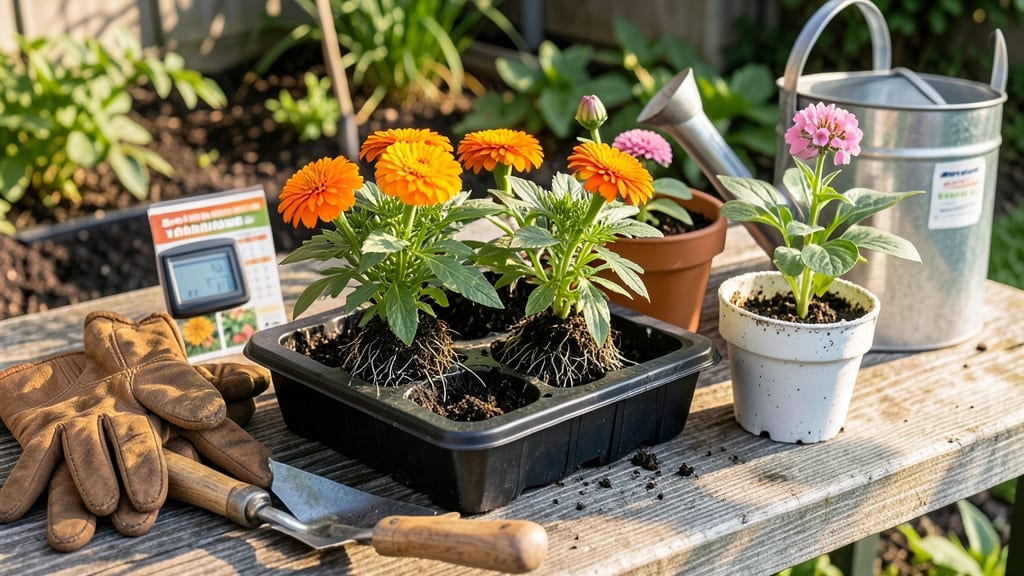
Planting flowers outside at the right time ensures vibrant blooms and healthy growth, but the perfect window depends on your climate zone and local conditions.
Timing your flower planting just right can mean the difference between a lush summer garden and a sad, wilted disappointment—but knowing the perfect window depends entirely on where you live.
Most gardeners aim for spring planting, but the exact moment varies by USDA zone, frost dates, and even your neighborhood’s microclimate. Too early, and frost will nip tender shoots; too late, and your flowers may struggle to establish roots before summer heat arrives.
In this guide, I’ll break down the ideal planting deadlines by region, share how to adjust for your local conditions, and reveal the best flowers to plant for your climate’s natural timeline.
🌱
When to Plant Flowers
Jan
❄️
Feb
❄️
Mar
🌱
Apr
🌱
May
🌱
Jun
🌱
Jul
☀️
Aug
☀️
Sep
🍂
Oct
🍂
Nov
🍂
Dec
❄️
USDA zone planting deadlines: exact weeks to plant flowers by region
Getting your flowers in the ground at the right time ensures vibrant blooms and healthy growth—but deadlines vary wildly across the U.S. From Zone 1's short summers to Zone 11's year-round warmth, your local frost dates determine everything.
I’ve broken down the exact weeks before/after your last frost when to plant annuals, perennials, and bulbs for each zone, plus regional tweaks like the Pacific Northwest’s cooler summers or the Deep South’s humid heat.
First, find your USDA Zone (check the USDA Plant Hardiness Map) and note your average last frost date. Most garden centers provide this locally, or use Almanac’s Frost Calculator.
For example, Zone 5 (like Chicago) has a last frost around May 15, while Zone 9 (like Los Angeles) rarely sees frost. Planting too early in cold zones risks frost damage, while waiting too long in warm zones can mean bolting or poor root establishment.
Here’s your zone-by-zone planting timeline, including bulbs (fall planting), cool-season annuals (spring/fall), and warm-season annuals (late spring). I’ve also included regional adjustments for areas like the Pacific Northwest (cooler summers) or Deep South (longer growing seasons).
| USDA Zone |
Bulbs (Fall) |
Cool-Season Annuals (Spring) |
Warm-Season Annuals (Late Spring) |
Perennials (Spring/Fall) |
Regional Notes |
| Zones 1-3 (Alaska, Northern Canada) |
8-10 weeks before last frost (Aug-Sept) |
4-6 weeks before last frost (May) |
2-3 weeks after last frost (June) |
Early spring or early fall (May/Sept) |
Short season! Use cold frames for extensions. |
| Zones 4-5 (Northeast, Midwest) |
6-8 weeks before last frost (Sept) |
4-6 weeks before last frost (April-May) |
2-4 weeks after last frost (June) |
Early spring or early fall (April/Sept) |
Pacific NW: Wait 2 weeks longer for warm-season plants. |
| Zones 6-7 (Southeast, Appalachia) |
6 weeks before last frost (Oct) |
3-5 weeks before last frost (March-April) |
After last frost (April-May) |
Early spring or fall (March/Oct) |
Deep South: Can plant warm-season as early as Feb. |
| Zones 8-9 (California, Gulf Coast) |
4-6 weeks before first frost (Oct-Nov) |
Year-round (cool-season) or after first frost (Nov) |
Feb-April (avoid summer heat) |
Fall or early spring (Oct/Feb) |
Desert zones: Water deeply before planting. |
| Zones 10-11 (Florida, Hawaii, Puerto Rico) |
Year-round (cool-season) or avoid summer |
Year-round (shade in summer) |
Feb-April or Sept-Oct (avoid peak heat) |
Year-round (shade-sensitive varieties) |
Tropical zones: Use mulch
How to adjust planting time for your local microclimate (even within the same zone)
Your USDA zone gives you a starting point, but microclimates within that zone can shift planting times by 2-4 weeks. For example, a mountain slope might need earlier planting than a valley just a few miles away. Even your backyard soil can create a microclimate that affects timing.
Urban areas often experience heat islands where pavement absorbs heat, making soil warmer earlier in spring. Meanwhile, coastal regions with chilly ocean breezes may delay planting until late May or June. These variations mean you can't rely solely on zone guidelines.
⚠️ callout-warning
⚠️ Microclimate Mistake Alert!
Planting cool-season flowers like pansies too late in Zone 6 because your backyard is warmer than average can lead to bolting (premature flowering) or poor growth. Always adjust your last frost date by 1-2 weeks if your microclimate runs hotter.
🌱 Pro Tip: Use a soil thermometer to confirm when your soil hits 60°F—the ideal temperature for most flowers.
One simple rule I use is the '10-day rule': If your microclimate is warmer than average, delay planting heat-sensitive flowers by 10 days. For cooler microclimates, plant 10 days earlier. This small adjustment can prevent heat stress or early frost damage.
Soil conditions also play a role. Sandy soil warms up faster in spring, while clay soil stays cooler longer. Amending your soil with compost can help regulate temperature.
If your garden sits in a low-lying area, cold air pools there, so plant frost-tender flowers like impatiens 2 weeks later than your zone suggests.
Wind exposure is another factor. Coastal gardens often experience salty winds that dry out soil faster, while inland areas may have drier, hotter winds. If your garden is windy, consider windbreaks or choose drought-tolerant flowers like lavender or yarrow, which thrive in exposed conditions.
To fine-tune your planting schedule, observe your garden for 3-5 years and note when flowers thrive or struggle. Keep a planting journal to track adjustments.
For example, I planted marigolds in early May for years, but after a few heat waves, I shifted to late May and saw 30% better blooms.
★★★★★4.6(3 reviews)
|